If you’ve spent any time researching the YoloCam S3, you’ve probably seen the term PDAF mentioned repeatedly as one of its defining features. Most webcam specs lists move on quickly after naming the autofocus type. But PDAF — Phase Detection Autofocus — isn’t just a marketing term. It represents a fundamentally different approach to how a camera finds and holds focus, and understanding why it works the way it does explains most of what makes the S3 stand out.
How Autofocus Actually Works: The Two Methods
To understand what makes PDAF different, it helps to first understand what the alternative — contrast-detection autofocus — does.
Contrast-Detection Autofocus (CDAF)
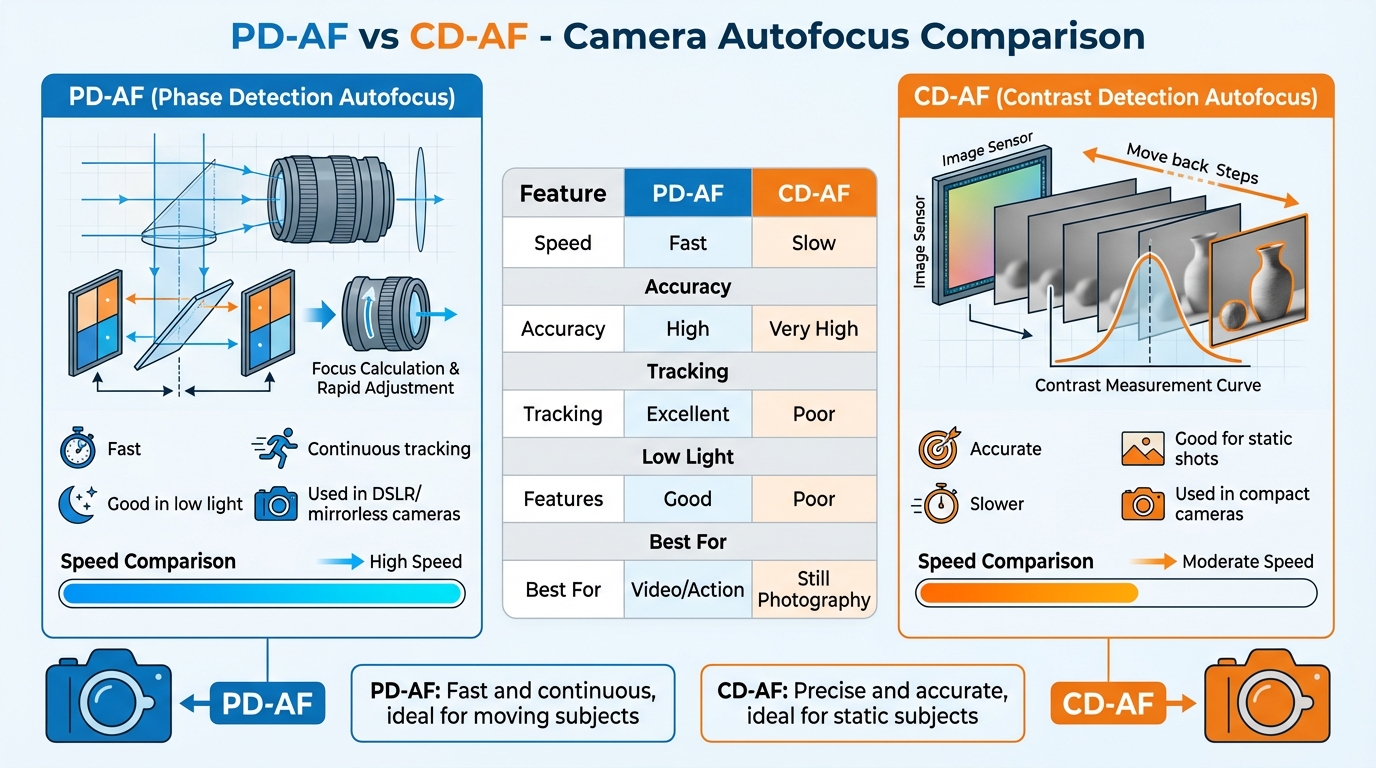
Contrast-detection autofocus works by analyzing the image being captured and adjusting the lens position until the contrast in the image peaks. The logic is straightforward: a sharp, in-focus image has high contrast between adjacent pixels; a blurry, out-of-focus image has low contrast.
The camera starts with the lens at its current position, evaluates contrast, moves the lens slightly, evaluates contrast again, and continues until it finds the position of maximum contrast. Once it has that position, it locks.
This works. For most webcams operating in stable conditions — a person sitting at a desk, not moving much — it produces acceptable focus most of the time. But it has inherent limitations:
It must search. Contrast-detection AF can’t directly calculate where focus should be. It has to hunt for the answer by trying different positions. In video, this hunting is visible as a brief blurring and refocusing — the classic “AF drift” that many webcam users have learned to tolerate.
It reacts rather than predicts. When you move toward or away from the camera, CDAF has to notice that focus has been lost, start searching again, and find the new correct position. The whole process takes time, and during that time, the image is out of focus.
It slows down in low light. Contrast is harder to measure in dim conditions where the image is noisy. CDAF systems become slower and less reliable when the scene is dark.
Phase Detection Autofocus (PDAF)
Phase detection autofocus works on an entirely different principle. Instead of searching for the maximum contrast position, PDAF directly measures where the correct focus point is before moving the lens.
Here’s how: PDAF uses dedicated phase detection pixels embedded in the image sensor. These pixels work in pairs, with each pair covered by a microlens that directs light from slightly different angles to each pixel in the pair. When the image is out of focus, the light arriving at each pixel in a pair is offset — this offset is the “phase difference.” The direction and magnitude of this phase difference tells the camera exactly which way to move the lens and by exactly how much.
The result is that PDAF can calculate the correct focus position from a single exposure. No searching required. The camera looks at the phase difference, computes the answer, moves the lens to that position, and focuses — often in a single step.
What This Means in Practice
The theoretical difference translates directly to what you see on screen:
No hunting. Because PDAF doesn’t need to search for focus, it doesn’t produce the characteristic blurring-and-refocusing cycle of contrast-detection cameras. When you move, the camera finds the new focus position immediately.
Instant lock-on. From a completely unfocused state, a PDAF system can achieve focus faster than a CDAF system can complete its first search pass. For a webcam that you might plug in and immediately need to start streaming, this matters.
Tracking through movement. If you lean forward, stand up, or move sideways across the frame, PDAF tracks you. The camera continuously monitors the phase difference on your subject and updates focus before the image has time to go soft.
Reliable in low light. Because PDAF doesn’t depend on high image contrast to function, it operates reliably in the dimmer conditions that cause contrast-detection cameras to lose confidence and hunt.
PDAF in the YoloCam S3: Real-World Performance
The S3 implements PDAF across a meaningful portion of its 1/1.3-inch sensor, which means the phase detection pixels are working with substantially more surface area than cameras that implement PDAF on smaller sensors. More phase detection coverage means more reliable tracking across the full frame, not just in the center.
In practice, the S3’s autofocus has been consistently described — across independent reviews and long-term user reports — as operating at a level that rivals dedicated mirrorless cameras. Users who work with Sony A7-series cameras as their primary cameras describe the S3’s autofocus as “nearly as fast as my main shooter.” That’s the comparison being made: not to other webcams, but to cameras that cost several times as much.
The three AF modes available in the Compose app give you control over the behavior:
Continuous AF (AF-C) — The default for most streaming and recording use. The camera continuously monitors focus and adjusts as you move. This is the mode that showcases PDAF’s tracking capability.
Single AF (AF-S) — The camera focuses once when triggered and holds that position. Useful for situations where you want a locked focal point regardless of subject movement.
Face Priority AF — The camera identifies and prioritizes faces in the frame. When multiple faces are present or when you move across the frame, the S3 tracks the prioritized face specifically. This is the mode most podcasters and multi-person streaming setups benefit from.
All settings are stored on the camera itself, so your AF configuration persists when you move the S3 to a different computer or setup.
Why Most Webcams Still Use Contrast Detection
If PDAF is clearly better, why isn’t it in every webcam?
The answer is cost and engineering complexity. Embedding phase detection pixels into an image sensor requires a specific sensor architecture that adds to manufacturing cost. For years, the cost was only justifiable at higher price points in standalone cameras — smartphones and mirrorless cameras.
As manufacturing costs have come down and sensor technology has matured, PDAF has started appearing in premium webcams. The YoloCam S3 is one of the first webcams to implement it at a price point accessible to most content creators and professionals — and it does so on a large 1/1.3-inch sensor rather than a small one, which amplifies the advantage.
Logitech’s MX Brio, Elgato’s Facecam 4K, and the discontinued Razer Kiyo Pro Ultra all use contrast-detection autofocus. The S3’s PDAF is a genuine differentiator, not a incremental improvement.
When PDAF Makes the Biggest Difference
The gap between PDAF and CDAF is most visible in specific scenarios:
Active movement. Streamers who gesture, lean in, or shift position during long sessions benefit most. The S3 keeps up with movement that causes CDAF cameras to hunt visibly.
Multi-person setups. When camera attention shifts between two people at different distances, PDAF handles the transition instantly. CDAF cameras can struggle with these shifts, especially if the distances are significantly different.
Low-light streaming. Evening streams and rooms lit only by monitors push CDAF cameras to hunt. The S3 maintains confident focus in these conditions.
Fast content changes. Gaming streams where the host turns to face a different direction, cooking streams with movement, fitness or tutorial content where the subject moves constantly — PDAF handles all of these without the AF drift that distracts viewers.
The Bigger Picture
PDAF is one part of what makes the S3 compelling, but it works in combination with the large sensor and capable software to produce something that behaves more like a camera than a webcam. The sensor gives the S3 the light-gathering and depth-of-field properties that produce a camera-like image. The PDAF gives it the focus reliability that camera-quality images demand. The Compose software gives you control over the output that most webcam apps don’t offer.
For creators and streamers who’ve tolerated autofocus drift for years without realizing it could be different — the S3’s PDAF is the part they notice first.
The YoloCam S3 is available at $199 from the YoloLiv official store, Amazon, and B&H.
43 total views, 43 views today

Meredith, the Marketing Manager at YoloLiv. After getting her bachelor’s degree, she explores her whole passion for YoloBox and Pro. Also, she contributed blog posts on how to enhance live streaming experiences, how to get started with live streaming, and many more.