Outdoor events are great opportunities to connect with audiences online. Concerts, sports games, festivals, and community gatherings can all reach viewers around the world through live streaming. However, streaming outdoors requires more preparation than streaming indoors.
A good live streaming setup for outdoor events needs to handle changing weather, bright natural light, large open spaces, and sometimes weak Wi-Fi. With the right tools and planning, you can still deliver clear, high-quality video to viewers in real time.
This guide explains the equipment, encoders, and streaming platforms you need to build a reliable outdoor streaming system.
Common Challenges of Outdoor Live Streaming
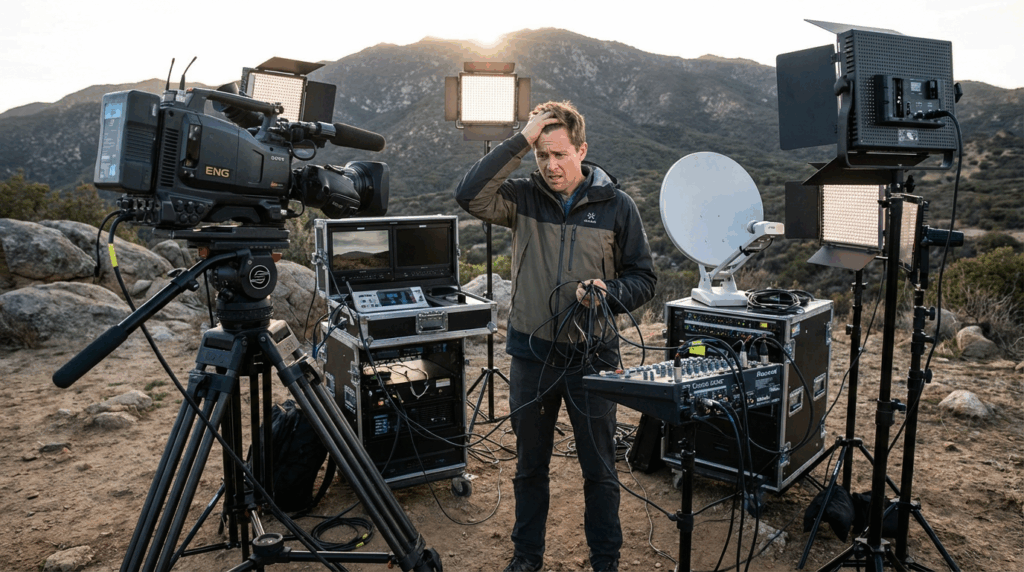
Streaming outside can be exciting, but it also brings several challenges.
Outdoor lighting can change fast, affecting your video quality.
Sunlight may improve visibility, but it can also make camera exposure harder to control. Using cameras with adjustable settings helps maintain stable video quality.
Second, outdoor locations often have large open spaces. This can make it harder to maintain a strong internet connection. Without a stable connection, your stream may freeze or lose quality.
Power supply is another important factor. Many outdoor events last for hours, and equipment needs continuous power. Portable battery packs or power stations keep cameras, encoders, and routers running during the event.
Finally, network reliability matters. Many crews combine mobile networks and venue Wi-Fi to improve stability during outdoor live streaming.
Essential Hardware for Outdoor Streaming
A typical outdoor streaming workflow includes cameras, a video switcher, an encoder, and network equipment.
Encoders are especially important because they convert video signals into formats that streaming platforms can deliver online.
Below are several well-known hardware encoders used in professional streaming setups.
Hardware Encoder Comparison
A strong live streaming setup for outdoor events requires cameras, a video switcher, an encoder, and reliable network equipment. Encoders convert video signals into formats supported by streaming platforms.

| Encoder | Key Features | Video Support | Connectivity | Best Use |
| Teradek Cube | Compact portable encoder | Up to 4K | Ethernet, Wi-Fi | Mobile productions |
| LiveU Solo | Bonded cellular streaming | HD | LTE, Ethernet | Remote outdoor events |
| Blackmagic ATEM Mini | Video switcher and encoder | HD / 4K models | Ethernet | Multi-camera streaming |
The ATEM Mini is widely used because it can combine multiple camera feeds. This allows producers to switch angles during the event and create a more professional broadcast.
Multi-camera production is common in sports, performances, and conferences because it improves the viewer experience.
Internet Connection for Outdoor Events
A reliable internet connection is one of the most important parts of outdoor live streaming.
Common connectivity options include:
- 4G or 5G mobile routers
- Venue Wi-Fi networks
- Bonded cellular connections
- Satellite internet in remote locations
Production teams often combine several connections to improve stability. If one network becomes unstable, another connection can continue the stream.
Portable routers and battery packs help maintain connectivity during long broadcasts.
Streaming Platforms for Outdoor Broadcasting
After video is encoded, it must be delivered to viewers through streaming platforms.
Two professional platforms often used by broadcasters are BoxCast and Dacast.
Streaming Platform Comparison
After you encode your video, you need a platform to distribute your content. Two well-known professional platforms are BoxCast and Dacast.
Streaming Platform Comparison
| Platform | Key Features | Monetization | Device Support | Best For |
| BoxCast | Simple setup and reliable delivery | Yes | Web, mobile, TV apps | Churches and small events |
| Dacast | Global CDN delivery and analytics | Yes | Multi-device viewing | Professional broadcasters |
Both services help deliver streams to viewers across different devices.
However, outdoor productions often need stronger transmission reliability and flexible infrastructure to handle large audiences.
Compared to these platforms, YoloCast stands out for outdoor events because it is an all-in-one platform with advanced encoding and stable transmission. It supports multiple streaming protocols including SRT, HLS, and RTMP, enabling smooth and reliable delivery even in challenging outdoor conditions. YoloCast’s modern cloud infrastructure, built on Kubernetes containerized clusters, automatically scales resources within 1–2 minutes to handle traffic spikes.
This allows streams to remain stable, regardless of sudden increases in viewers.
Why YoloCast Works Well for Outdoor Streaming
For event producers who want a complete solution, YoloCast offers powerful tools designed for professional streaming.
YoloCast is an all-in-one platform where users can manage encoding, distribution, and stream delivery in one place.
1. Stable Outdoor Transmission
Outdoor environments can be unpredictable. YoloCast supports multiple streaming protocols that improve stability:
- SRT
- HLS
- RTMP
These protocols help maintain stable real time streaming even when network conditions change.
2. Modern Cloud Infrastructure
Many traditional streaming systems rely on older server architectures.
YoloCast uses a modern Kubernetes containerized system, similar to the infrastructure used by companies like Google and Netflix.
This system offers strong elastic scaling. It can automatically add or reduce resources within one to two minutes depending on traffic demand. This keeps streams stable even when audience numbers increase suddenly.
3. Multi-Platform Streaming
YoloCast allows broadcasters to send streams to 10–30 or more platforms at the same time.
This means a single broadcast can reach viewers on:
- YouTube
- Twitch
- Websites or custom players
Multi-platform streaming helps event organizers expand their audience and increase engagement.
4. AI Real-Time Subtitles
YoloCast also includes AI real-time subtitle technology.
Automatic captions help viewers follow content more easily. Subtitles also improve accessibility for international audiences and people watching without sound.
Simple Workflow for Outdoor Live Streaming
A typical outdoor streaming process includes several steps:
- Capture video with professional cameras.
- Use a switcher such as ATEM Mini to combine multiple cameras.
- Encode the video signal.
- Connect to a stable internet connection.
- Deliver the stream through reliable streaming platforms.
When you carefully plan each step, your broadcast maintains strong video quality and delivers smoothly in real time.
Start Streaming Outdoor Events with YoloCast
Outdoor broadcasting is becoming more popular every year. Events of all sizes now use live streaming to reach audiences beyond the physical venue.
A reliable live streaming setup for outdoor events helps ensure viewers enjoy clear video and stable playback.
For a powerful platform designed for modern streaming workflows, YoloCast is a strong option. It offers stable transmission, flexible cloud infrastructure, and multi-platform distribution.
You can explore the platform and start streaming today by visiting here:
https://www.yololiv.com/yolocast-overview
With the right tools and platform, your outdoor events can reach viewers anywhere and deliver smooth, high-quality streams.
3,568 total views, 43 views today

Betty,As a Customer Success Specialist at YoloLiv, she is passionate about helping users understand YoloCast’s features and resolve day-to-day usage challenges. In addition to hands-on support, she creates practical articles that share tips, troubleshooting guidance, and best practices to help users get more value from YoloCast.